Thank you to everyone who joined our April 23rd town hall on school funding. It was amazing to have so many parents, teachers, and community members join to learn more about opportunities where we can collectively make a difference. Our big takeaway: the funding challenges are real—but so are the opportunities to change the system.
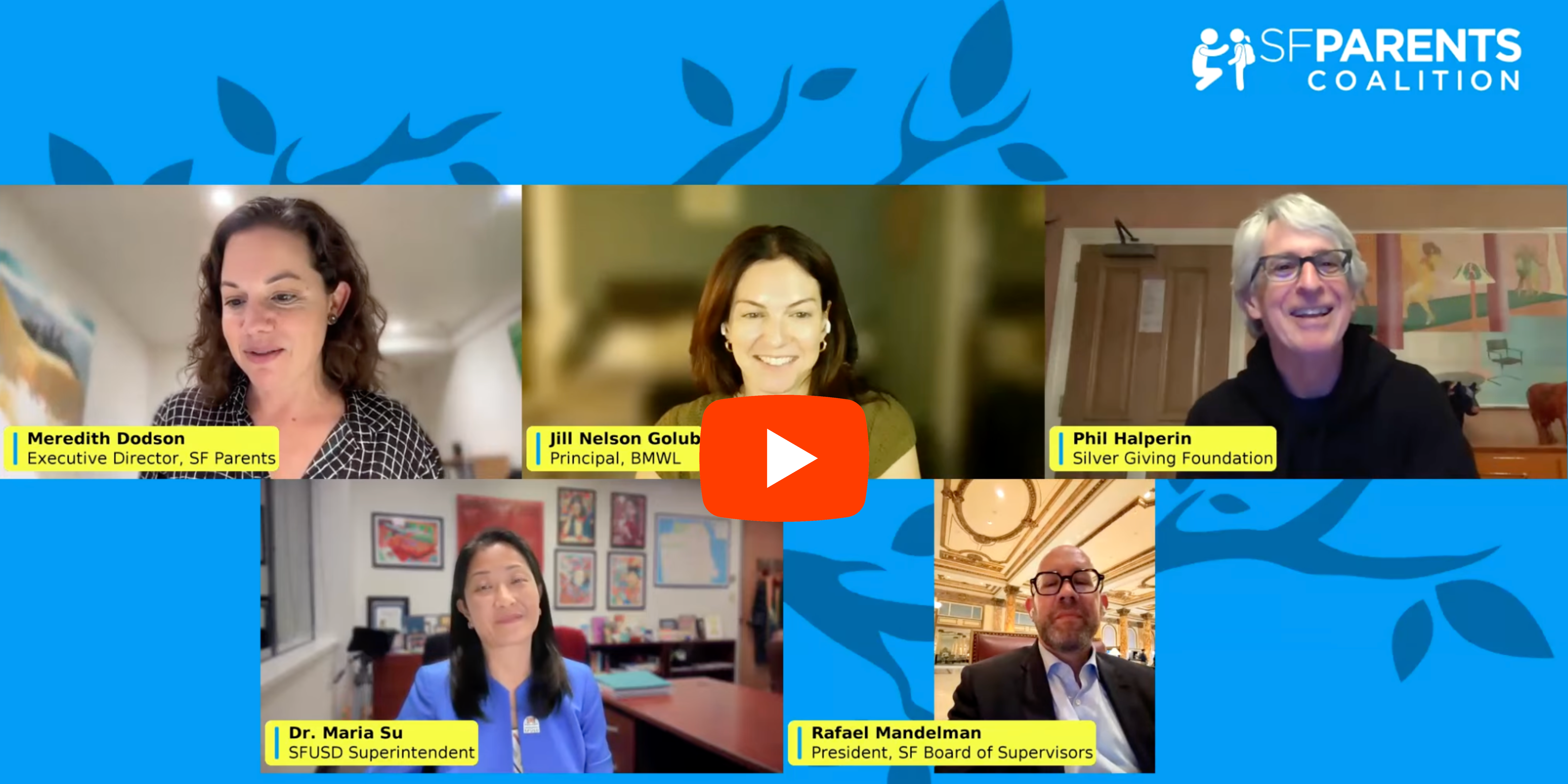
The event kicked off with an address from Chief Kunal Modi from the Mayor’s Office, followed by a panel including Superintendent Maria Su, Board of Supervisors President Rafael Mandelman, Phil Halperin of Silver Giving, and Jill Nelson Golub of BMWL.
Below you can find a summary of the town hall including key takeaways, and our best five options for taking action. We learned together that our best path forward includes:
- Action 1: Push for changes in Sacramento that could bring more money to our schools locally.
- Action 2: Protect our ability to pass future school funding measures by preventing the “Save Prop 13” statewide business group effort from passing.
- Action 3: Make existing local dollars work better – easing restrictions from the past to respond better to today’s student needs.
- Action 4: Prepare now for 2028 local campaigns.
- Action 5: Treat enrollment as a funding strategy.
If the full summary below feels like a lot and you’re ready to move from learning to action, we need you with us. SF Parents is building a coalition to win real, sustainable funding for our schools and it starts with you.
|
How We Can Bring More Funding to SF’s Public Schools
Setting the stage: SFUSD is facing a structural budget gap (ongoing expenses exceed ongoing revenue). But our district is not alone – this is something districts across California are facing, even if it is still a real problem to solve. The key drivers of this gap are declining enrollment and absenteeism, rising special education costs, and the expiration of one-time federal funds.
The good news: SFUSD is in a much more stable financial position than it was a year ago. Under Dr. Su’s and the current school board’s leadership, SFUSD has moved from crisis management toward stability, and by June is expected to reach positive certification with the CA Department of Education, meaning it can finally cover expenses for the current year and the next two years. This is important!
That progress matters. But it also made clear that stabilizing the budget is not the same as fully funding our schools. If we want the schools we dream of for SF’s kids, we also need a strategy to bring in more revenue. Read on to learn what we, together, can do to bring more revenue to SFUSD:
1. Push for changes in Sacramento
Panelists at the town hall described that several of the most important opportunities are at the state level. For example, SFUSD is currently working with other large urban districts to advocate for changes to California’s school funding formula, including:
- funding districts based on enrollment instead of average daily attendance
-
updating how poverty is calculated for supplemental funding to districts
-
protecting districts from sudden enrollment-related funding losses
-
increasing state support for special education
These changes could make a meaningful difference for San Francisco and other urban districts facing declining enrollment and rising costs. What can you do about it? Pay attention to the CA gubernatorial race and the State Superintendent for Public Instruction race. Listen closely: What positions are these candidates taking on the recommendations from large urban districts, described above? Thank you to the three SFUSD parent leaders who have already signed up to develop a questionnaire to submit to the candidates! The rest of you: Stay tuned for their responses.
2. Protect our ability to pass future school funding measures
Panelists warned us all about a November statewide ballot measure referred to in the town hall as “Save Prop 13.” They explained how it could make it harder to pass future local revenue measures for schools.
First – What is Prop 13? Proposition 13 is a California law passed in 1978 that limits how property taxes are calculated. It caps property tax rates at 1% of a property’s assessed value and limits annual increases in assessed value to 2%, unless the property is sold. Before Prop 13, local property taxes were a major, stable source of school funding. After Prop 13, that funding dropped significantly and became more centralized at the state level. California now relies more on income and capital gains taxes, which are less stable and harder to predict. This contributes to budget volatility and uncertainty for districts like SFUSD.
Why is this an immediate priority? This collective action will be a defensive one. By opposing the new business effort to “save Prop 13” in November, we can protect our ability to win future school funding at the ballot box.
3. Make existing local dollars work better
During his address, the Mayor’s Office Chief Modi shared that the City of San Francisco contributes (far) more local funding to public schools than any district in CA, at ~$240M annually (roughly $3,000 per student). The panel then discussed the Student Success Fund, a local funding set-aside passed by voters in 2022 which was designed to bring more money to schools to improve student outcomes. While the fund brings significant dollars to SFUSD — currently $35M/year and up to $60M/year over time — overly rigid rules have limited schools’ ability to use the money effectively for tutoring, academic supports, wellness supports, and key staffing.
Superintendent Dr. Su and Board of Supervisors President Mandelman both agreed the restrictions need to loosen, whether through ordinance changes or a broader charter amendment process following the city budget cycle. There was strong interest in pursuing those changes to make the fund more flexible and impactful for students. Stay tuned as we learn more about the action opportunities here.
4. Prepare now for major 2028 local campaigns
Silver Giving Foundation’s Phil Halperin brought up two major funding measures that directly support public schools and are coming up locally, expected in 2028:
- Quality Teacher and Education Act renewal (parcel tax): This local tax provides funding for teacher salaries, classroom support, and key school programs. It expires in 2028, so voters will need to decide whether to renew it—and potentially increase it to better meet current needs.
- School facilities bond: This type of measure funds repairs, upgrades, and improvements to school buildings across the district, helping ensure students have safe, modern learning environments.
Panelists at our town hall emphasized that winning these measures will require early organizing, strong parent turnout, and broad coalition-building. San Francisco has a strong track record of approving school funding measures, but that success depends on families showing up. We’ve spoken recently with UESF, United Educators, about the importance of collaborating on these local efforts and we’re looking forward to seeing parents and teachers mobilize together to win these two critical measures in 2028!
5. Treat enrollment as a funding strategy
Enrollment decline as a major driver of budget challenges was on everyone’s mind. Superintendent Dr. Su shared SFUSD’s priorities for increasing enrollment, including expansion of TK, the launch of a new K-8 Mandarin immersion school in 2027-28, and generally improving academics and the enrollment experience. Because school funding is tied to students, enrollment matters. District leaders explained that bringing more families into SFUSD is itself a revenue strategy.
SF Parents has been working on this strategy for years through our enrollment workshops, our I 💙my public school campaign, opinion pieces that rewrite the false narrative about our schools, and other parent-led collaborative efforts. We’re hoping to expand this work but we need your help!! Don’t forget to sign up here and we’ll let you know about the next opportunity to get involved.
|
Next, SF Parents will be getting in touch with everyone who signs the pledge, to share concrete ways to plug in, whether that’s supporting state advocacy, engaging in local ballot measure strategies, growing our funding action team, or helping build the parent and community base needed to win in 2028.
If we want more funding for our schools, we need to start organizing now.
This conversation made one thing clear: these challenges are complex, but there are real opportunities ahead, and parent voices – and energy! – will matter. We already heard from you in our Facebook poll that many of you are energized and ready to go.
Strong parent participation will be critical to passing local funding measures that support our schools. If you’re interested in getting more involved, SF Parents will be organizing around these efforts above. To be successful, we need you to join us:
|
WAS THIS EMAIL HELPFUL?
📬 FORWARD ME TO A FRIEND! 📬
Or, received this email from a friend? Subscribe here
SF Parents Coalition is a 501c3 nonprofit that centers the needs of children and youth in San Francisco public schools by bringing together a diverse network of parents and caregivers to advocate for a thriving, equitable school system.
Join as a member, volunteer, or donate to support our work!
SF Parent Action is our affiliate 501c4 organization that empowers public school parents in San Francisco to advocate for policy change and local candidates who support public school families and students.
Update your newsletter language preference here.
在此處更新您的首選語言,開始及時接收中文或西班牙文訊息。
Actualice su preferencia de idioma aquí para comenzar a recibir comunicaciones oportunas en español en lugar de inglés.
|
|