

Public commenting is an important opportunity to make your powerful voice heard.
Let the S.F. Board of Education and SFUSD Leadership know how parents and caregivers feel, how the district can do better for our city’s kids, our teachers, and our schools!
Learn more about how to attend a meeting or make a public comment here.
Please note that as SF Parents is focused on our core issues, we only do
the summary/takes on the most pertinent agenda items related to our advocacy campaigns.
If you see that something on the BOE agenda is omitted, it is likely for this reason.
10/13/2026 Regular Meeting at 6:30pm:
- Full meeting agenda on BoardDocs here.
- Zoom link here – Password: 291561.
- Agenda summary from SF Parent Coalition follows below.
SF PARENT’S SUMMARY:
BUDGET: SFUSD ended the 2025-26 fiscal year in a better financial position than originally projected, but serious structural budget challenges remain. The district continues to rely on reserves to cover expenses, raising questions about long-term financial stability and whether resources are reaching classrooms.
SCHOOL REORGANIZATION: Tonight, the Board will decide between Option B (Neighborhood + All Schools) and Option C (Neighborhood + Citywide Programs). Both guarantee a neighborhood school, but only Option B explicitly preserves families’ ability to apply to other neighborhood schools when space is available.
SFUSD’s own engagement data shows that surveyed families, particularly Black and low-income families, rated Option B more favorably. District simulations also project greater concentrations of poverty under Option C.
Tonight’s question: Will the Board let family feedback and evidence guide its decision?
Item I.1 Action Item: Approval of Fiscal Year 2025-26 Unaudited Financial Report (presentation link here, report link here)
During the 2025-26 fiscal year, SFUSD faced several budgetary challenges. The district was subject to a “negative” fiscal certification from the California Department of Education (CDE) and under oversight from two state-appointed experts to implement fiscal stabilization activities. That year’s budget reflected millions in budget cuts and realignments. At Tuesday’s Board meeting, the district is presenting the FY 2025-26 Unaudited Actuals report that shows how the district’s financial activities actually performed against the budget.
It turns out that SFUSD’s overall General Fund was better off financially in FY 2025-26 than originally budgeted:
- Its beginning fund balance was actually $429 million, or $133 million higher than the $296 million budgeted
- It received $112 million more in revenue than budgeted
- It anticipated a -$106 million budget deficit for FY 2025-26, but the shortfall was far smaller, only -$5 million

Source: SF Parent Coalition’s analysis of SFUSD FY 2025-26 Unaudited Actuals Presentation
The FY 2025-26 Unaudited Actuals also reveals some bad budgetary news:
- SFUSD’s Restricted General Fund expenditures exceeded its revenues by nearly $200 million (see line C, column A, below). This deficiency was covered by a nearly $230 million “contribution” from the Unrestricted General Fund (see line D.3, columns A and B, below) to pay for restricted categorical programs such as Special Education
- SFUSD continues to utilize its fund balance reserves to cover its operating deficit. The district used $127 million of its fund balance in FY 2025-26 (see row E. column C), leaving a beginning fund balance of $302 million for the start of this current fiscal year. This current rate of spending would leave SFUSD without sufficient budget reserves in two fiscal years
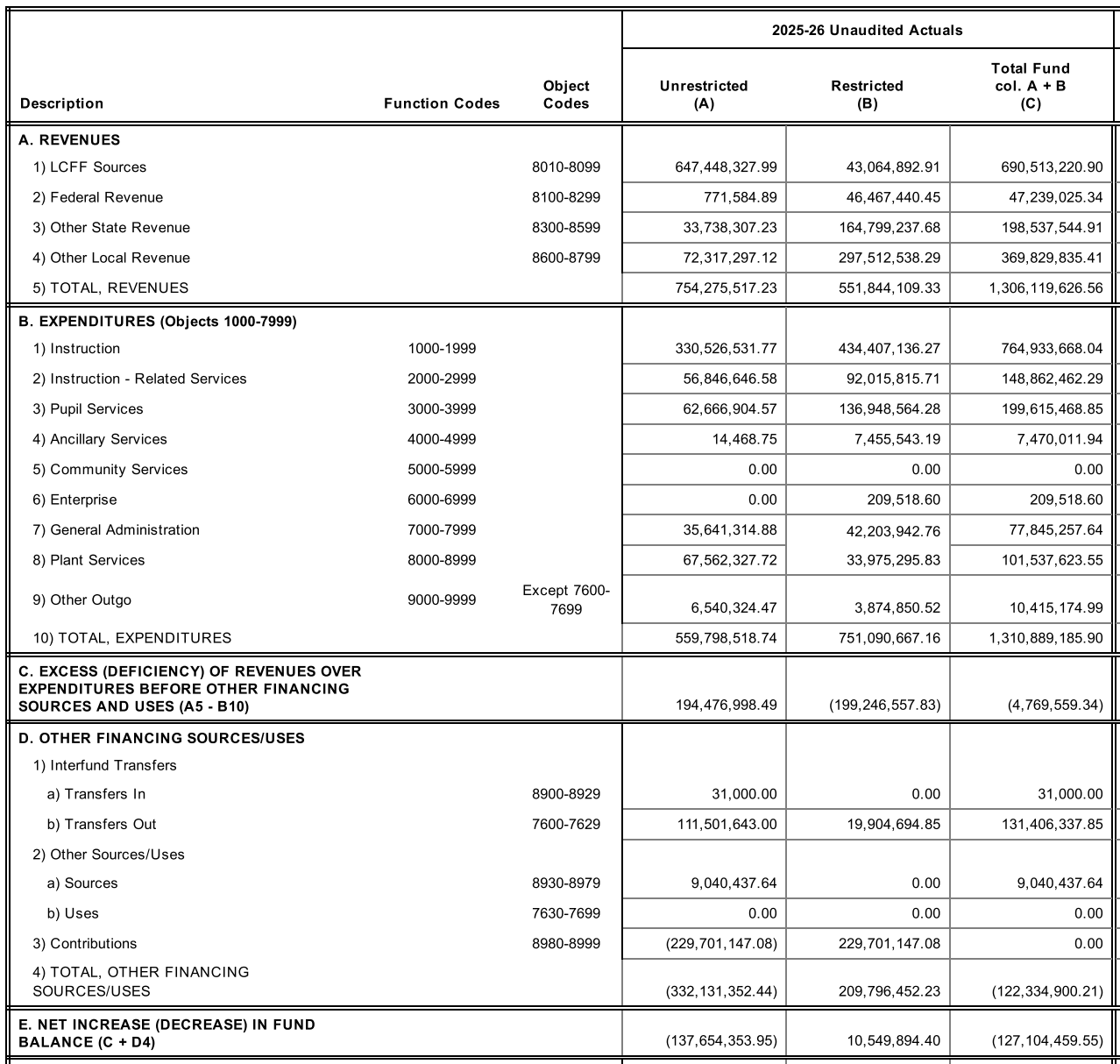
Source: FY 2025-26 Unaudited Actuals Report Form 01
OUR TAKE: SFUSD’s 2025-26 Unaudited Actuals report shows a mix of good and bad financial news for the district. Parents need SFUSD to provide clarity on what this information means.
- In June 2026, when SFUSD adopted its budget for this fiscal year, the district “self-certified” that it had achieved a “positive” fiscal certification, meaning that it could meet its financial obligations for the current fiscal year and the two subsequent fiscal years. However, the CDE’s official certification will be issued in December. Does the FY 2025-26 Unaudited Actuals identify risks to district solvency in future years?
- What is the district’s plan to stabilize expenditures in the Special Education program to reduce contributions from the Unrestricted General Fund to the Restricted General Fund?
- Why hasn’t SFUSD spent $149 million in “Other Restricted Local” fund balance?
- What is the status of the district’s Fiscal Stabilization Plan (link), which described budget cuts and realignments that were to be implemented through FY 2027-28?
- What is the rational relationship between the budget shown in the overall district budget and the resources that school sites can use to develop their School Plans for Student Achievement (SPSAs)? (SPSAs are presented at this Board of Education meeting as Consent Agenda item F.11, link to SPSA folder here.) What ensures that school sites actually receive the funds they need to implement their plans to improve student outcomes?
Items H.1 and I.2 / I.3 Discussion and Action Item: School Reorganization, Elementary School Assignment Policy Direction (presentation link here, Resolution for Option B link here, Resolution for Option C link here)
SFUSD has completed three “study sessions” to identify options for a new elementary school assignment policy. On October 6th, the Board chose two options for final consideration at the October 13th meeting:
- Option B: “Neighborhood + All Schools”
- Option c: “Neighborhood + Citywide Programs”
OUR TAKE: Is the Board Listening to Parents?
The Board will discuss these two options and then direct the Superintendent to develop an implementation plan for one option. The first reading for the new Board Policy to implement the changed student assignment process will be held by March 30, 2027, and the final adoption is scheduled for April 13, 2027.
SF Parents believes Option B, Neighborhood + All Schools, offers the strongest path forward. Both options guarantee a neighborhood school, but only Option B preserves families’ ability to apply to other neighborhood schools when space is available.
SFUSD’s own data shows that families, particularly Black and low-income families, rated Option B more favorably. District simulations also project greater concentrations of poverty under Option C. Why would the Board move forward with an option that raises these concerns without clearly explaining its reasoning?
We also know that improving schools takes time. Changing school assignments won’t fix the academic disparities that exist today. Families need meaningful choices while SFUSD works to improve every school.
The district asked families what they wanted. Now it’s time for the Board to listen. Tonight, commissioners must demonstrate that parent feedback, equity, and student outcomes are driving their decision.
As a reminder – SF Parents’ community continues to demand from SFUSD:
AN INCREASED, DEMONSTRATED FOCUS ON STUDENTS: We want to see the district’s clear plan and commitment to a baseline of excellence and equity across every SFUSD school. Without clarity, analysis, and follow-through on how decisions impact student outcomes, it’s impossible to know if SFUSD is truly prioritizing what matters most—student learning and success. Through our SF Kids Can’t Wait campaign, families continue to call for urgent improvements in literacy and math outcomes for SFUSD.
GREATER TRANSPARENCY AND COMMUNITY ACCESSIBILITY:
Families deserve open, honest communication about how decisions are made and how funds are spent. SFUSD must provide clear data and impact analysis for all major initiatives, including how they support student achievement. The Board should not approve budgets or plans without confidence in their accuracy or their impact on teaching and learning.
REAL ACCOUNTABILITY AND STRONG GOVERNANCE:
SFUSD must move beyond promises to consistent, measurable action. Strong governance from the Board of Education is essential to restoring trust and delivering results for students. Commissioners must remain focused on student outcomes, fiscal responsibility, and transparency, and hold district leadership accountable for following through on commitments and delivering measurable progress.