

Parents in our community are actively discussing what the proposed enrollment changes could mean for families. One concern we’re hearing: there may be a disconnect between what commissioners are saying and what parents are experiencing / what matters to families.
Before choices are restricted, families need to be heard and understood.
What do you want the district and Board of Education to understand about school enrollment, choice, and what will most benefit students across SFUSD? Email us at hello@sfparents.org and let us know what you think.
This meeting was the Board of Education’s second study session for its proposed school reorganization. Discussing this item, and specifically the three remaining policy options, was the only item on the agenda.
Background
SFUSD currently uses a citywide choice system for elementary school enrollment, where families have priority (but not a guarantee) to attend a school in their neighborhood, but can apply to any school across the district. In 2020, the Board approved a move to a zone-based system, but implementation was repeatedly delayed. The district is now reconsidering how student assignment should work, with a new system expected to take effect in the 2028–29 school year. At the first study session on August 18, district staff presented four possible approaches:
- Large Zones — Families would choose among schools within relatively large geographic zones. This was the option commissioners essentially rejected at the August meeting because some zones would require impractical travel for families.
- Small Zones — families could apply to any school in a small zone (roughly 2–5 schools), plus designated citywide programs.
- Neighborhood + All Schools — families would have a guaranteed local school but could still apply to schools in other neighborhoods where seats are available, as well as designated citywide schools/programs.
- Neighborhood + Citywide Programs — families would have a local school, with choice outside the neighborhood limited primarily to programs and schools designated as citywide.
The Board eliminated the Large Zone option from consideration, leaving three options for further discussion. This week, commissioners took a deeper dive into those remaining options and their tradeoffs.
Item C.1 School Reorganization #2 (Study Session #1 recap here; Study Session #2 presentation link here)
Dr. Su kicked things off by reminding everyone that this meeting was about building understanding, not making a decision. She made it clear that there is a lot of work to be done before a decision is made, and as several commissioners emphasized later in the meeting, community engagement needs to happen first. There will be a final vote on the plan to be implemented on April 13th, 2027, and the timeline on slide 2 ladders back to that, so changes can be implemented by October 2027 for the 2028-29 enrollment season. However the board needs to provide more specific direction to the district at their meeting on October 13, 2026, so that staff can fully build out an option suitable for a vote.
Another important caveat made by staff was that all mapping examples presented were illustrative, but would not be the exact boundaries/recommendations for each option. The actual boundaries would be created between October 2026 and April 2027 before the final vote. This is concerning to us as it feels like the Board is being asked to make decisions with inaccurate and old data.
Staff outlined the Objectives for the night’s working meeting on slide 2 :
- Understand what families have told us, and where those priorities conflict with each other
- Test each policy model against seat capacity
- Surface the tradeoffs each model creates, including where they are very different from the current status
- Confirm what the board needs to see before Study Session 3 on October 6
In Session 1, the BOE commissioners said that all neighborhood schools must be “strong” – slide 9 represents SFUSD’s work-in-progress definition of this. Hours after it was presented, President Kim challenged the proposed definitions, suggesting others such as “has at least 2 full classes in each grade level.” Commissioner Weissman-Ward and Gupta also wanted operational definitions, as well as a timeline for the district to create ‘quality schools.’
Capacity matching is a dynamic challenge, and for the long term planning that is being done here, demographic shifts have to be taken into consideration. For example, slide 17 shows how, based on capacities, SOMA and Bayview have a shortage of seats in their neighborhood schools if all students attended their neighborhood schools based on 2033 projections. It wasn’t clear to us what capacity meant, as some schools were shown as having different capacity numbers than they have current students (for example – Miraloma was listed as having capacity for 44 in kindergarten but has 66 now, as well as 2 TK classrooms). Issues with the accuracy of the district’s data is an ongoing issue – if we can’t trust the data, it is impossible to properly assess the options being presented.
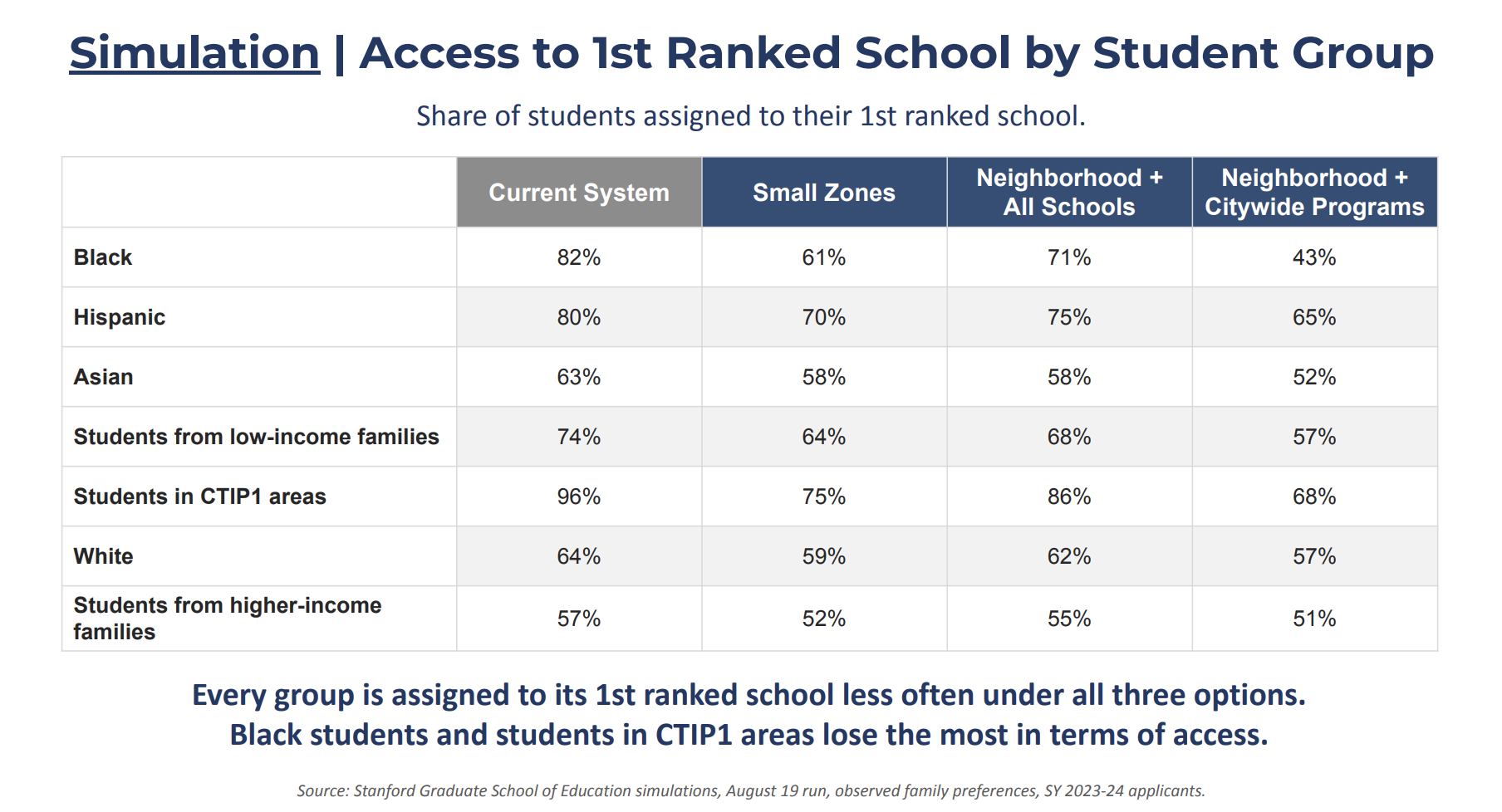
In comparing options based on the district’s three stated priorities (predictability, proximity, and diversity), SFUSD is in a tricky position, as it is not legally allowed to use race to define boundaries or make assignment decisions. Instead, it uses poverty rates as a proxy, as defined by Free and Reduced Lunch (FRL) percentages. This is another point where data accuracy becomes a concern, as many families don’t fill out the associated forms each year, leading to potential underreporting. There is also an important equity consideration here. The simulations show that the impacts of these options are not evenly distributed across student populations. The Board needs to understand who benefits, who may be negatively impacted, and ensure that a new policy does not put historically underserved students at greater risk.
Slide 25 was presented to the board, comparing all 3 options vs. our current system based on the 3 priorities, and led to robust discussion. President Kim challenged the logic of the referenced Stanford study on poverty as it applies to SFUSD, essentially saying it doesn’t apply since the district can reallocate resources to improve schools in disadvantaged neighborhoods. In his opinion this nullifies this priority as a comparison point between the options. Vice President Huling agreed, saying that instead of encouraging movement within the district, we should improve the schools in the neighborhoods, and echoing comments made in Session 1. We agree that SFUSD needs to invest in making every school excellent, but that work will take time, resources, and sustained, intentional effort. Strong schools are not created simply by adding more money or staff, and meaningful improvement will not happen overnight. If families are going to have greater reliance on their neighborhood schools, SFUSD needs a credible plan for ensuring that access to a neighborhood school means access to an excellent education.
Other notable comments from commissioners throughout the meeting:
- Commissioner Fisher: while choice has been eliminated as a priority, she is hearing from families that they want choice until SFUSD improves schools. Commissioner Huling disagreed, arguing that choice has only increased segregation. Commissioner Alexander echoed Huling’s comments, arguing that choice creates a doom loop – by allowing a few families to go elsewhere, this causes low enrollment, which means the school will have more combo classes, fewer resources, and worse overall quality. However, we will note that 40% of the district’s spots are in city-wide programs (language programs or K-8 schools), which is more than a few families, so unless we are eliminating those programs or forcing people into them, choice must be a part of this system for those seats.
- We applaud Commissioners Ray and Fisher for stating that they want the district to talk to people to understand what they want – families need to be heard. Ray warned against in-person town halls, as they tend to see the same people at these over and over, instead recommending virtual events or surveys.
- Vice President Huling once again called for the district to pre-invest in underperforming schools to draw more families in; examples included funding fulltime librarians, instructional coaches, T10s, ahead of any portfolio changes (which would otherwise follow enrollment changes). However considering a decision has to be made by April, and the pressure Vice President Huling and other board members have put on the district to act quickly, there doesn’t seem to be enough time to make these types of changes before a decision on the new system is voted on.
- Commissioner Huling wanted the Neighborhood + All Schools option removed from consideration. Commissioners Alexander, Gupta and Ray were concerned that taking options off the table now, before we have heard from communities, doesn’t make much sense. We also want to note that the Neighborhood + All Schools option comes closest to giving Black and Hispanic families the same access to their 1st ranked school as the current system, while the citywide option most negatively affects the first choice options for those families. None of the new options provides Black and Hispanic better access to their 1st ranked school.
The district will make a decision on which option to build out for the April 2027 vote in roughly 6 weeks. Engaging families before that decision is made is imperative – and we hope the Board and the District keep that in mind moving forward.